Focused at the interface of nano-engineering, photonics, metamaterials, and DNA-nanotechnology, we create new nano-scale tools, materials, and technologies for practical applications in optics, sensing, bio-imaging, and healthcare.
Post Doctoral Research Associate position available
Contact Alasdair.clark@glasgow.ac.uk for more details
Artificial Taste Buds for industrial, environmental, and medical applications
A number of projects are available, including:
Artificial Taste Buds – Can We Digitise Mammalian Taste?
We have digital equivalents for sight, hearing, and touch, but we have no digital equivalent of taste or smell. In this project, the student build bio-inspired chemical-intelligence systems using cross-reactive photonic arrays. Working with collaborators across in academia (engineers, chemists, AI-experts, sensory and nutrition experts) and industry, the student will investigate the use of these tools as analogues for human taste, exploring routes towards taste digitisation.
Artificial Taste Buds to monitor drinking water treatment sites
There are currently no tools available to drinking water providers that enable real-time water quality monitoring at treatment facilities. Water providers are forced to use centralised lab facilities to monitor water health, meaning they cannot react to problems in a timely manner. In this project, the student will join ongoing activity with Scottish Water to investigate the development of a new nanophotonic sensing tool for real-time water quality monitoring at treatment sites. The student will develop the tool and the underlying technology for the challenges unique to this sector.
Artificial Taste Buds for Industrial deployment
Industrial scale production of liquids products requires rigorous quality control. Unfortunately, the tools used to check the chemical content of these liquids live many miles away (sometimes hundreds of miles away) from the production facility, in centralised laboratories. This leads to a wait time of days-to-weeks for results. We have developed a new technology that enables rapid, on-site chemical profiling of liquids. In this project, the student will work directly with industrial partners across a variety of sectors to test the technology in challenging environments and to further develop the tool for new applications.
Detecting the Undetectable
Many industrial and healthcare problems are driven by molecules that slip through the fingers of current sensing technologies. These compounds, off-flavours, treatment by-products, early markers of disease, often have no suitable natural binders, meaning there are no antibodies, aptamers, or other receptors that can be used to build a simple, selective sensor.
As a result, many targets remain effectively “undetectable” at the point of need. Industries must rely on centralised laboratory methods to find them days or weeks after the problem has occurred.
Our technology changes that landscape. We combine nanophotonic metasurfaces with molecularly imprinted polymers (MIPs) to create sensors capable of detecting these otherwise “undetectable” targets where they matter – on a production line, at a treatment plant, or at the bedside -without waiting for lab results.
In this project, the student will help develop and refine this platform, working with partners in the drinking-water and beverage sectors to deliver real-time detection of targets that currently have no practical on-site sensing solution.
Biodegradable optical components – Next-gen green metasurfaces
Advanced photonic devices (metasurfaces, holograms, micro-optics) are usually made from materials that linger in the environment for decades or require energy-intensive fabrication. In this project, the student will design and manufacture optical metasurfaces made entirely from biodegradable, non-toxic, and even edible materials. The goal is to create a new class of sustainable photonic components that offer the capabilities of state-of-the-art micro- and nano-structured optics without the environmental cost.
These devices could enable eco-friendly security labels, authenticity tags, sensors, disposable optical elements, and packaging-integrated photonics, all designed to break down harmlessly at end-of-life.
The student will gain experience in nanoscale design, cleanroom or benchtop fabrication techniques suitable for soft/biopolymer materials, and optical characterisation. The work sits at the intersection of photonics, sustainability, and materials innovation, an opportunity to help define what “green optics” can become.
We’re recruiting a PDRA to join us at the University of Glasgow on a project to develop a new sensing tool with real-world impact. This PDRA will lead the development of a compact device for on-site detection of trace contaminants in whisky, working in partnership with the Scotch Whisky Research Institute, whose members produce ~90% of Scotland’s whisky by volume. The RA will take a proven nanophotonic sensor and integrate the optical, fluidic, and software components needed to turn it into a deployable prototype. If you’re a pratically-minded engineer who enjoys hands-on system integration and wants to work at the interface of photonics, sensors, and industry, we’d be thrilled to receive your application. Apply here: https://www.jobs.ac.uk/job/DPO752/research-associate
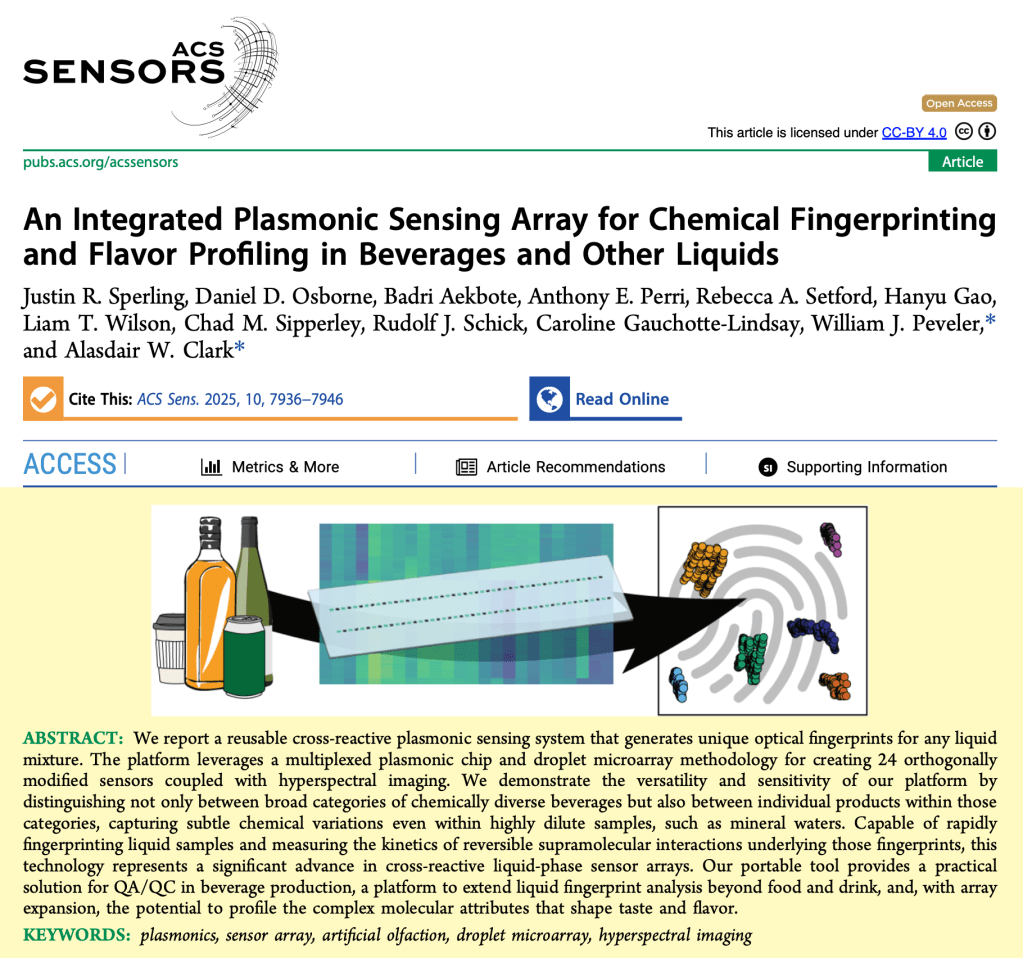
Our new paper on cross-reactive plasmonic metasurfaces for universal liquid sensing applications has been published in ACS Sensors. This represents the first example of a solid-state, reusable “tongue” sensor for chemical composition monitoring in liquids.
The paper is Open Access and can be found here: An Integrated Plasmonic Sensing Array for Chemical Fingerprinting and Flavor Profiling in Beverages and Other Liquids https://doi.org/10.1021/acssensors.5c02485
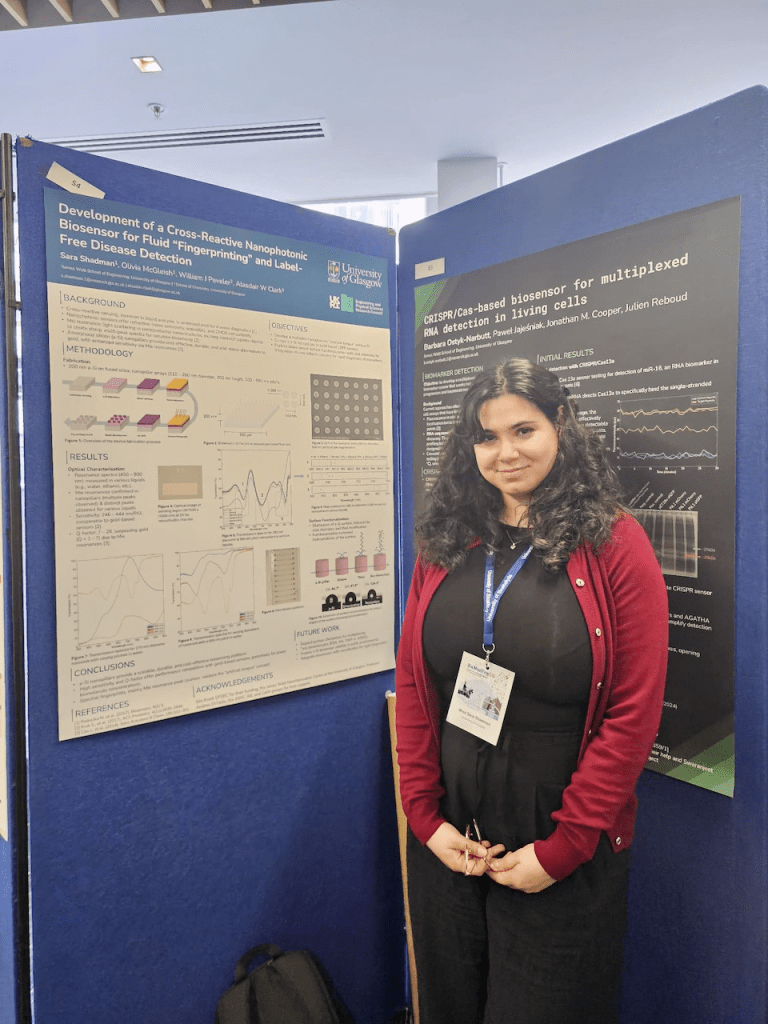
Huge congratulations to my PhD student, Sara Shadman, who came 3rd in the Best Poster competition at BioMedEng25 for her poster: “Development of a Cross-Reactive Nanophotonic Biosensor for Fluid ‘Fingerprinting’ and Label-Free Disease Detection” Sara is taking our successful plasmonic metasurface “tongue” sensors and translating them into an all-silicon nanophotonic platform. This next-generation approach could offer improved stability—both physically and chemically—over gold-based sensors, opening up new possibilities for real-world applications in fluid analysis and disease detection. Really proud to see Sara’s hard work recognised.
We are very happy to have recently had Finlay Walton join our group. Finlay will be working on our Artificial Taste-Bud technology; looking at new applications and doing some tech development.
Sara Angelucci’s first paper was recently published in @OpticaPubsGroup Optics Express. Happy to be a part of it. Well done Sara. https://doi.org/10.1364/OE.513829
“Structured light enhanced machine learning for fiber bend sensing”







 AW Clark Research